

Pīti and sukha are paired repeatedly in descriptions of the early jhānas, but they are not identical. Pīti is commonly translated as rapture, joy, interest, uplift, or energized delight. Sukha is pleasure, ease, happiness, or well-being. Different translators and meditation teachers map bodily versus mental aspects differently, so it is safer for beginners to understand the functional contrast: pīti is more activating; sukha is more settling and satisfying.
| Quality | Pīti | Sukha |
| Typical tone | Energized, uplifting, thrilling, enlivening | Comfortable, satisfying, peaceful, pleasant |
| Possible phenomenology | Tingling, waves, gooseflesh, lightness, buoyancy, joy, surges | Ease, warmth, contentment, softness, quiet happiness |
| Role in progression | Prominent in first and second jhāna; fades before third | Prominent through first three jhānas; relinquished in fourth |
| Common mistake | Trying to intensify it into fireworks | Clinging to comfort and resisting further refinement |
Classical texts describe multiple grades of pīti in later analysis, but intense energy phenomena are not a universal admission ticket. Some meditators experience dramatic waves; others experience a quieter uplift. Treating one person’s nervous-system signature as the definition of jhāna is a category error.
Chasing pīti can create a feedback loop of excitement: a pleasant sensation appears, the meditator thinks “this is it,” arousal rises, breathing changes, and concentration breaks. The practical response is counterintuitive–enjoy the wholesome pleasure without leaning toward it. Let stability become more interesting than intensity.
Entry is usually easier when it is the continuation of a stable process rather than a sudden attempt to cross a conceptual border. Once the hindrances are quiet and the object or wholesome pleasure is self-sustaining, intention can become lighter. Different traditions use different entry cues–settling into pīti-sukha, attending to a nimitta, expanding a kasiṇa, or allowing the unified breath-body field to dominate.
Stability improves when the meditator does less unnecessary checking. Repeatedly asking “Am I in first jhāna yet?” reintroduces evaluation at precisely the point where evaluation may need to quiet. If the state is stable, let it teach its own texture. Learn what strengthens it, what disturbs it, and how effort changes inside it.
Traditional systems often recommend deliberate emergence and review. After the state ends, note which factors were clear, what the transition felt like, whether the hindrances returned, and whether the state can be re-entered. This builds discrimination without turning the sit itself into a committee meeting.
Figure 10 – State transition model
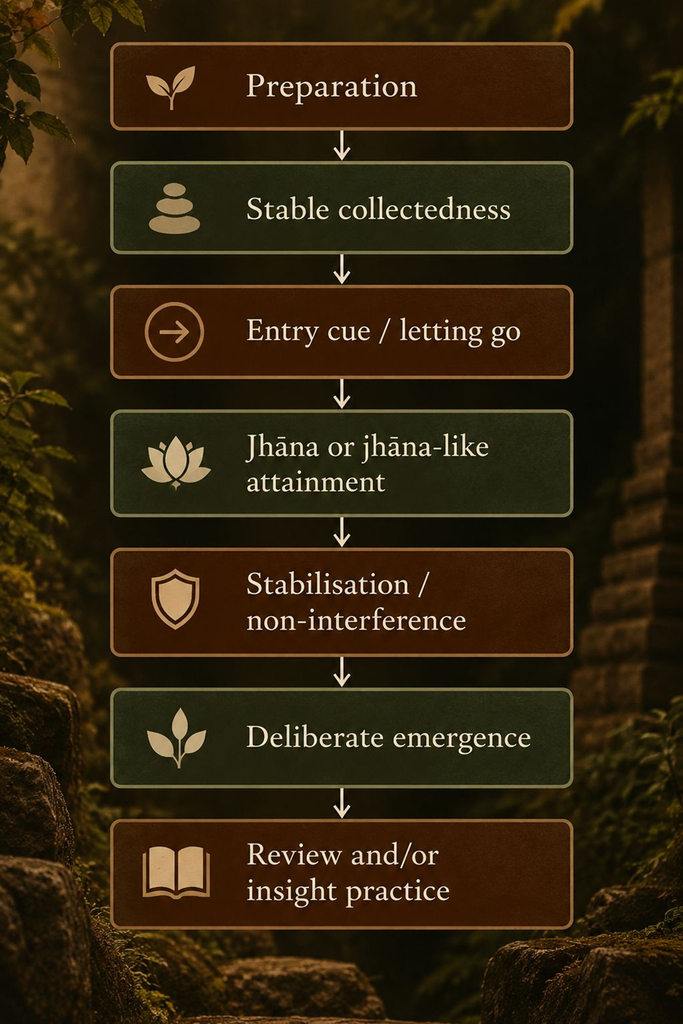
In later Theravāda manuals, mastery is analyzed in terms of skills such as entering, remaining, emerging, and reviewing according to intention. A beginner need not turn these into performance tests, but reproducibility is more informative than one dramatic event.