

The most confusing feature of modern jhāna discussion is that different teachers use the same word for states with different entry thresholds. Arguing over labels without first specifying criteria is therefore unproductive. A practical comparison needs at least three axes: sensory withdrawal, method of entry, and stability/absorption threshold.
| Model (simplified) | Typical emphasis | Sensory awareness | Nimitta/access concentration | Caution |
| Early-discourse/sutta-oriented reading | Standard formulas, hindrance abandonment, embodied pīti-sukha, progressive refinement | Interpretations vary; texts do not give a single laboratory-style sensory cutoff | No universal bright-nimitta requirement stated in the standard formula | “Sutta jhāna” itself includes multiple modern readings. |
| Theravāda commentarial/Visuddhimagga | Precisely analyzed absorption, meditation signs, object mastery | Very deep withdrawal in mature absorption | Strongly systematized; access and absorption concentration are explicit categories | A later synthesis, not simply a transcription of every earlier sutta. |
| Modern deep-absorption systems | Profound stillness, strong nimitta or equivalent, little ordinary sensory engagement | Often minimal external sensory awareness | Frequently central | Criteria differ even among “deep jhāna” teachers. |
| Modern lighter/accessible systems | Stable collectedness, pīti-sukha, reproducible stages useful for insight | Some sensory awareness may remain | May use access concentration pragmatically; bright visual nimitta often not required | Critics may regard the threshold as too low; advocates see it as closer to some sutta readings. |
Figure 6 – Conceptual spectrum, not a ranking
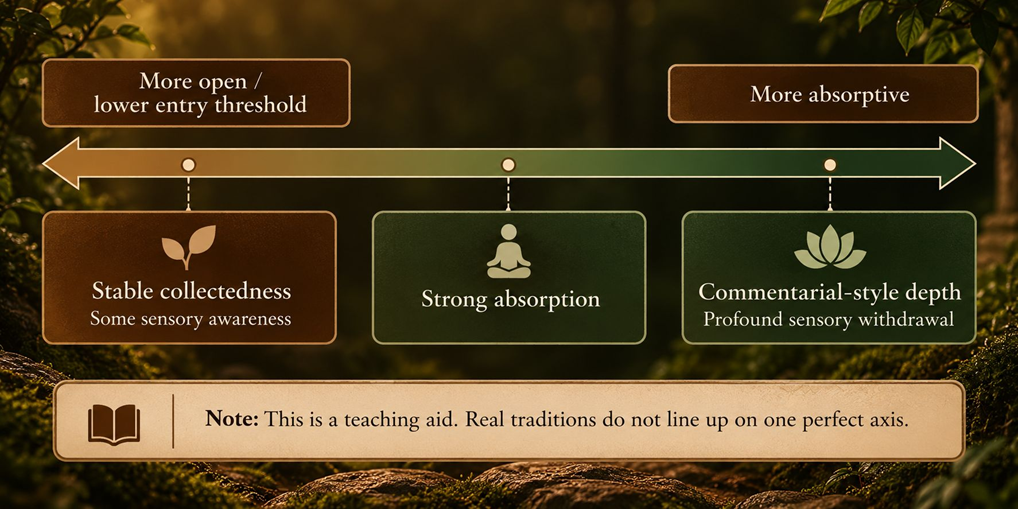
Modern teachers and books show this diversity. Leigh Brasington teaches an accessible approach using pīti-sukha and a pragmatic notion of access concentration. Pa-Auk-style systems emphasize detailed commentarial concentration and nimitta development. Ajahn Brahm’s teaching strongly emphasizes deep stillness and luminous nimitta. None of these summaries should substitute for reading the teachers in their own words.
| Key takeaway: Before asking whether a meditation “counts,” ask: Which textual model? Which entry criteria? Which phenomenology? Which purpose? Many apparent contradictions are disagreements over definitions. |
References: Buddhaghosa, Visuddhimagga Chapters III–IV; Leigh Brasington, Right Concentration; Ajahn Brahm, Mindfulness, Bliss, and Beyond; Pa-Auk Tawya Sayadaw, Knowing and Seeing.
Nimitta is one of the most confusing words in modern concentration discussions because it has multiple meanings across Buddhist literature. Broadly it can mean a sign, mark, theme, or basis. In later Theravāda meditation manuals it becomes a technical term for mental signs associated with concentration, especially the learning sign (uggaha-nimitta) and counterpart sign (paṭibhāga-nimitta).
In Visuddhimagga-style kasiṇa and breath systems, the counterpart sign can become a stable mental object leading from access concentration into absorption. In some modern lineages a bright luminous nimitta is treated as a major milestone and a practical gateway to deep jhāna. Other sutta-oriented systems do not require a visual light or disc before applying the term jhāna.
MN 128 is useful for historical caution. It discusses perception of light and forms in meditation and the factors that destabilize concentration, but the word nimitta in early contexts does not simply mean “a bright light seen with closed eyes.” Therefore, seeing lights, geometric patterns, or internally generated imagery does not by itself prove that a canonical or commentarial nimitta has arisen.
| Common error: Do not equate every flash of light, hypnagogic image, or visual after-effect with “the nimitta.” Ask how the term is defined in the practice system you are actually following. |
References: MN 128; Buddhaghosa, Visuddhimagga Chapter IV.
Access concentration (upacāra-samādhi) is a highly useful concept in Theravāda commentarial and modern teaching systems. The Visuddhimagga distinguishes access concentration from absorption concentration (appanā-samādhi): in access, the hindrances are suppressed and jhāna factors are developing, but the absorption is not yet fully established; in absorption, the jhāna factors are strong and the mind is firmly established in the attainment.
The caution is historical, not practical. The standard early-discourse formula does not present a named stage “access concentration” immediately before each jhāna. So a teacher can legitimately use the concept as a later technical tool, but should not imply that the early suttas themselves give the full later taxonomy.
Modern teachers also use “access concentration” differently. In an accessible pīti-sukha system it may mean a period of stable attention with few thoughts, sufficient to shift toward a pleasant sensation. In a deep commentarial system it may be associated with a mature nimitta and far stronger sensory withdrawal. Comparing practice reports requires knowing which threshold is meant.
| Key takeaway: Access concentration is a valuable map term, but not a universal cross-tradition measurement unit. |
References: Visuddhimagga III–IV; compare early jhāna formulas in DN 2 and SN 45.8.