
Meditation did not appear in a cultural vacuum. Early Buddhist texts depict the future Buddha training with Āḷāra Kālāma and Uddaka Rāmaputta before his awakening, mastering the dimension of nothingness and the dimension of neither-perception-nor-non-perception respectively. MN 26 then portrays him as leaving because these attainments did not by themselves lead to the liberation he sought. Scholars disagree about how much of this account can be reconstructed historically and how it relates to early Brahmanical or other śramaṇa practices. Alexander Wynne, for example, argues that the two teachers and associated formless methods likely reflect genuine pre-Buddhist contemplative traditions; this remains a scholarly argument rather than a settled fact.
The four jhānas themselves occupy a distinctively central place in early Buddhist training. In several discourses they appear after ethical restraint, sense restraint, mindfulness, contentment, and abandonment of the five hindrances, and before insight or higher knowledges. This location matters: jhāna is not presented as an isolated altered-state hobby, but as one stage in a broader path of cultivation.
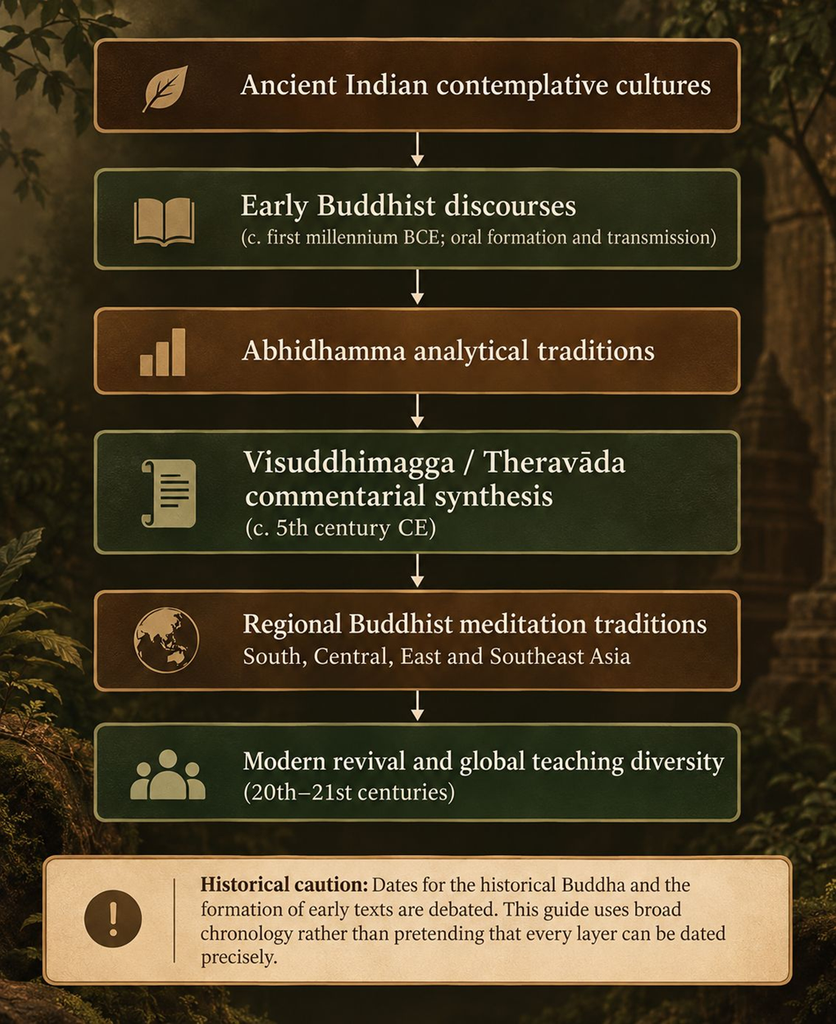
The Nikāyas and parallel Āgama materials give recurring formulas for the four jhānas but relatively little practical detail about exactly how a meditator transitions from ordinary attention into them. Abhidhamma literature analyzes mental factors with increasing granularity. Later Theravāda commentaries, especially Buddhaghosa’s fifth-century Visuddhimagga, provide a much more elaborate meditation technology: meditation objects, preliminary signs, learning signs, counterpart signs, access concentration, absorption concentration, mastery, and precise factor analysis.
This later system is historically influential and internally coherent, but it should not be retrojected into every earlier discourse. A beginner can respect the Visuddhimagga while still noticing that some of its technical vocabulary and entry criteria are not stated in the standard early-jhāna formula.
The Sanskrit word dhyāna was transmitted into Chinese as chán and into Japanese as zen. This linguistic history is real, but it does not mean that all Chan or Zen meditation is simply practice of the four Pāli-canon jhānas. East Asian traditions developed their own contemplative vocabularies, methods, doctrinal contexts, and uses of the inherited term.
In the twentieth and twenty-first centuries, jhāna became increasingly visible among lay practitioners, retreat communities, Western Theravāda teachers, and secular contemplatives. Contemporary systems range from relatively accessible “sutta-jhāna” approaches to highly absorptive systems influenced by commentarial criteria. The resulting “Jhāna Wars” can sound like a disagreement over who is right, but much of the conflict disappears when teachers state their definitions and textual assumptions clearly.
Figure 2 – A simplified historical timeline
References: MN 26; DN 2; Alexander Wynne, The Origin of Buddhist Meditation (2007); Buddhaghosa, Visuddhimagga.