
Jhāna and insight are sometimes presented as rival camps: concentration people pursue bliss, insight people pursue reality. That caricature does not do justice to Buddhist texts or living traditions. The more useful question is how tranquility and investigation are sequenced and integrated.
| Model | Basic sequence | Rationale |
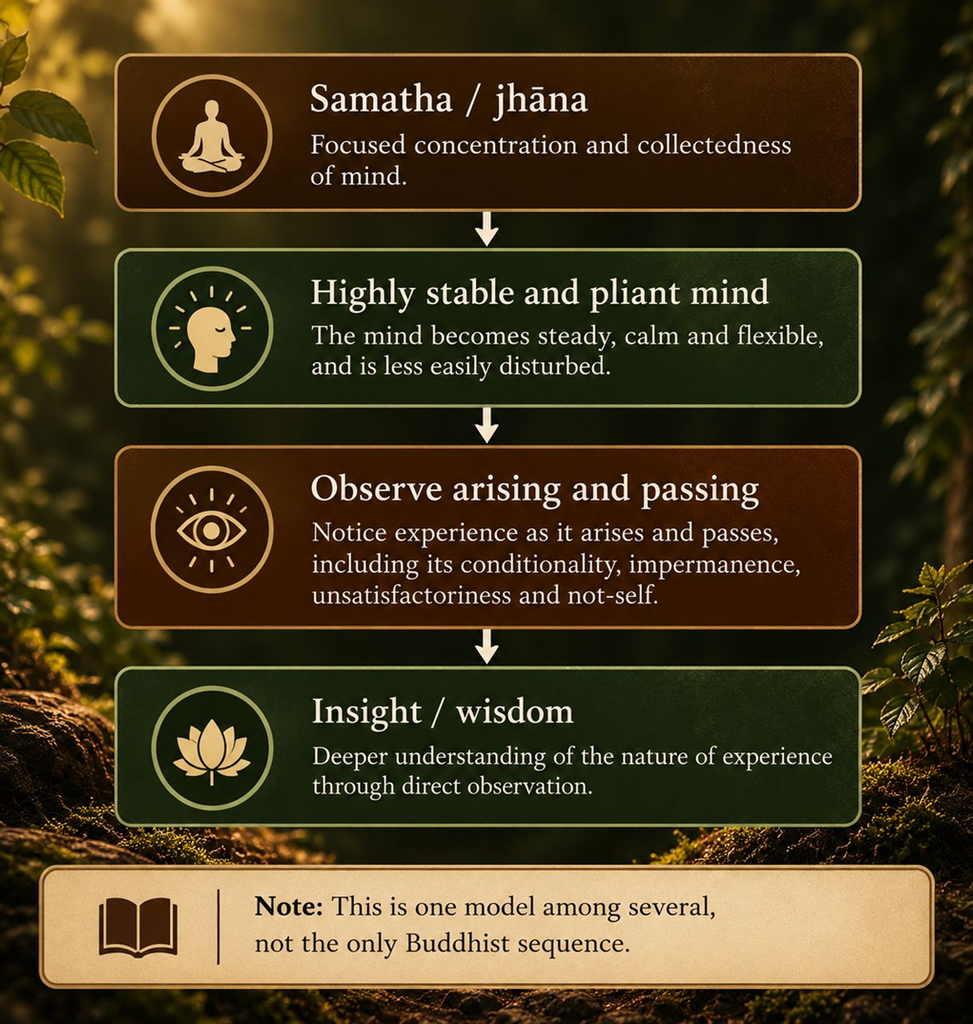
| Samatha first | Develop strong calm/jhāna, then turn the collected mind toward insight | A stable mind can observe phenomena with less distortion and reactivity. |
| Alternating practice | Move between jhāna and analytical/insight periods | Each mode strengthens the other while preserving distinct skills. |
| Emergence-based insight | Enter jhāna, emerge, then examine factors or impermanence | Uses the clarity and afterglow of absorption for investigation. |
| Integrated samatha-vipassanā | Calming and seeing are cultivated together throughout the meditation | Rejects a strict two-stage model; stability and insight mature interactively. |
| Insight without strong absorption mastery | Develop insight using mindfulness and sufficient moment-to-moment stability | Common in modern vipassanā lineages; deep jhāna may be optional rather than prerequisite. |
Figure 11 – One common samatha-to-insight model
MN 118 itself is a useful reminder that breath practice can include both settling and insight. Its final tetrad turns explicitly toward impermanence, fading, cessation, and relinquishment. Meanwhile, texts such as MN 111 analyze successive meditative attainments in relation to discernment. Traditions differ in how literally they translate these structures into retreat technique.
| Key takeaway: Samatha asks the mind to become less scattered; vipassanā asks it to see more clearly. In mature practice these aims can support rather than sabotage each other. |
References: MN 118; MN 111; AN 4.170 and related samatha-vipassanā discussions.
Deep jhāna is normally a dedicated meditation session, not a background mode for driving a car, chairing a meeting, or walking through traffic. Daily-life integration means carrying forward qualities developed around the attainment: less compulsive attention switching, greater ease with silence, faster recovery from irritation, and more confidence that calm can be internally cultivated.
If deep concentration makes daily life more brittle, detached, grandiose, or avoidant, something needs recalibration. The traditional test of practice is not how exotic a state sounds in a retreat interview, but whether greed, aversion, confusion, and reactivity are being understood and weakened.
No responsible timetable can promise jhāna in eight weeks. The following plan trains prerequisites and gives enough continuity for a beginner to discover what stronger samādhi feels like.
| Period | Suggested practice | Primary goal |
| Weeks 1–2 | 15–20 minutes most days; settle posture; know the breath clearly; gentle return | Familiarity and consistency |
| Weeks 3–4 | 20–30 minutes; notice hindrances; reduce unnecessary effort; lengthen continuous attention | Stability without strain |
| Weeks 5–8 | 30–45 minutes if comfortable; emphasize tranquility, whole-body ease, and fewer interventions | Let calm become self-sustaining |
| Beyond | Gradually longer sits or occasional retreat days; choose one coherent jhāna method; consider skilled feedback | Depth, reproducibility, and clearer criteria |
| Expectation management: Progress is nonlinear. Sleep, stress, retreat conditions, ethical conflict, illness, novelty, and practice history can change concentration dramatically. A timetable is for habit formation, not attainment certification. |