

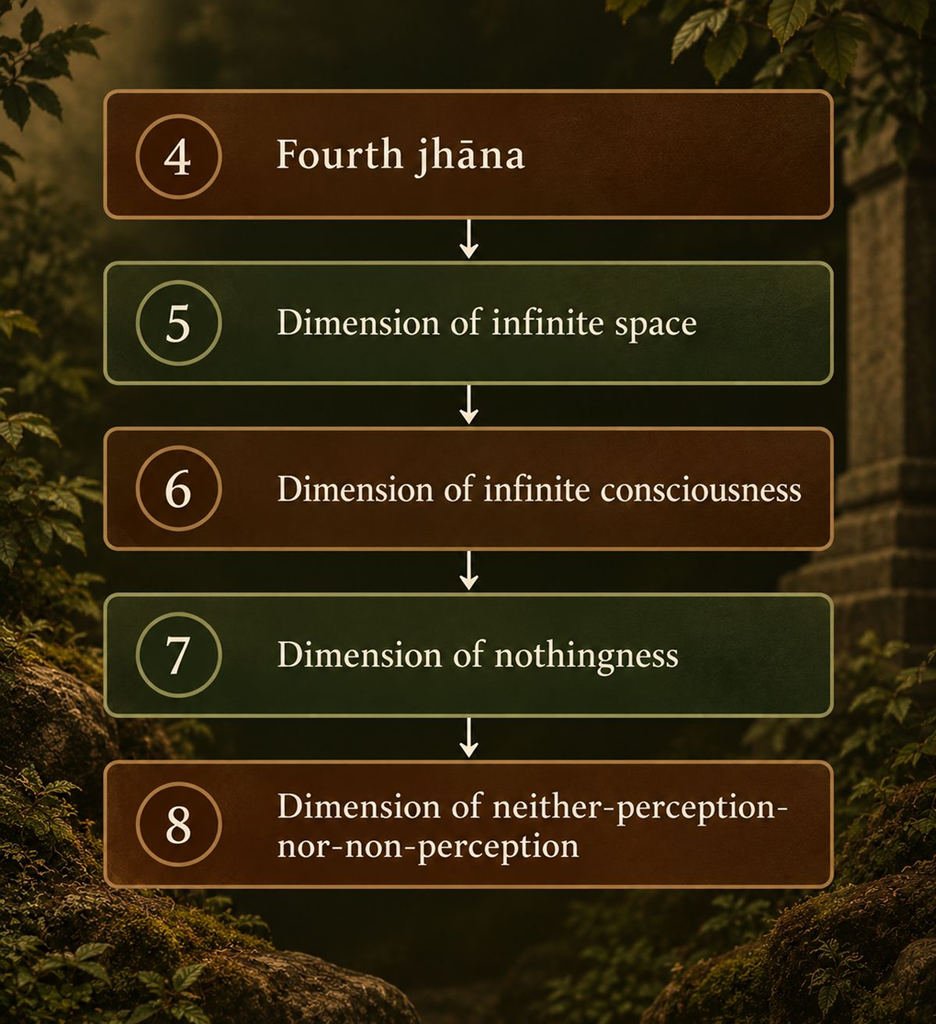
After mastery of the fourth jhāna, many Buddhist meditation maps describe four increasingly subtle formless attainments, arūpa-samāpatti. Modern teachers often call them “jhānas five through eight” for convenience. Early Buddhist texts, however, frequently distinguish the four jhānas from the four formless dimensions. Both naming conventions are common, so a beginner should always ask which convention a teacher is using.
The meditator moves beyond ordinary perception of form and attends to boundless or infinite space. The emphasis is no longer on a bounded body or material meditation object but on spatial limitlessness.
Attention shifts from the boundlessness of space to the apparent boundlessness of the consciousness knowing it. The change is subtle: the field of knowing becomes the salient theme.
The meditator attends to the absence or “nothingness” of the previous field. MN 26 associates this attainment with Āḷāra Kālāma.
Perception becomes so refined that ordinary categories of perceiving and not perceiving no longer apply straightforwardly. MN 26 associates this attainment with Uddaka Rāmaputta’s tradition.
Figure 5 – Formless attainment stages
Some texts then describe the cessation of perception and feeling (saññāvedayitanirodha/nirodha-samāpatti) for highly developed practitioners. It should not simply be marketed as “ninth jhāna.” Traditional presentations connect it with advanced liberating attainment and specific prerequisites.
| Terminology note: “Jhāna 5–8” is convenient modern shorthand. “Four formless attainments” better preserves the distinction often made in early textual classification. |
References: MN 26; MN 111; DN 9; AN 9 collections on successive attainments.