
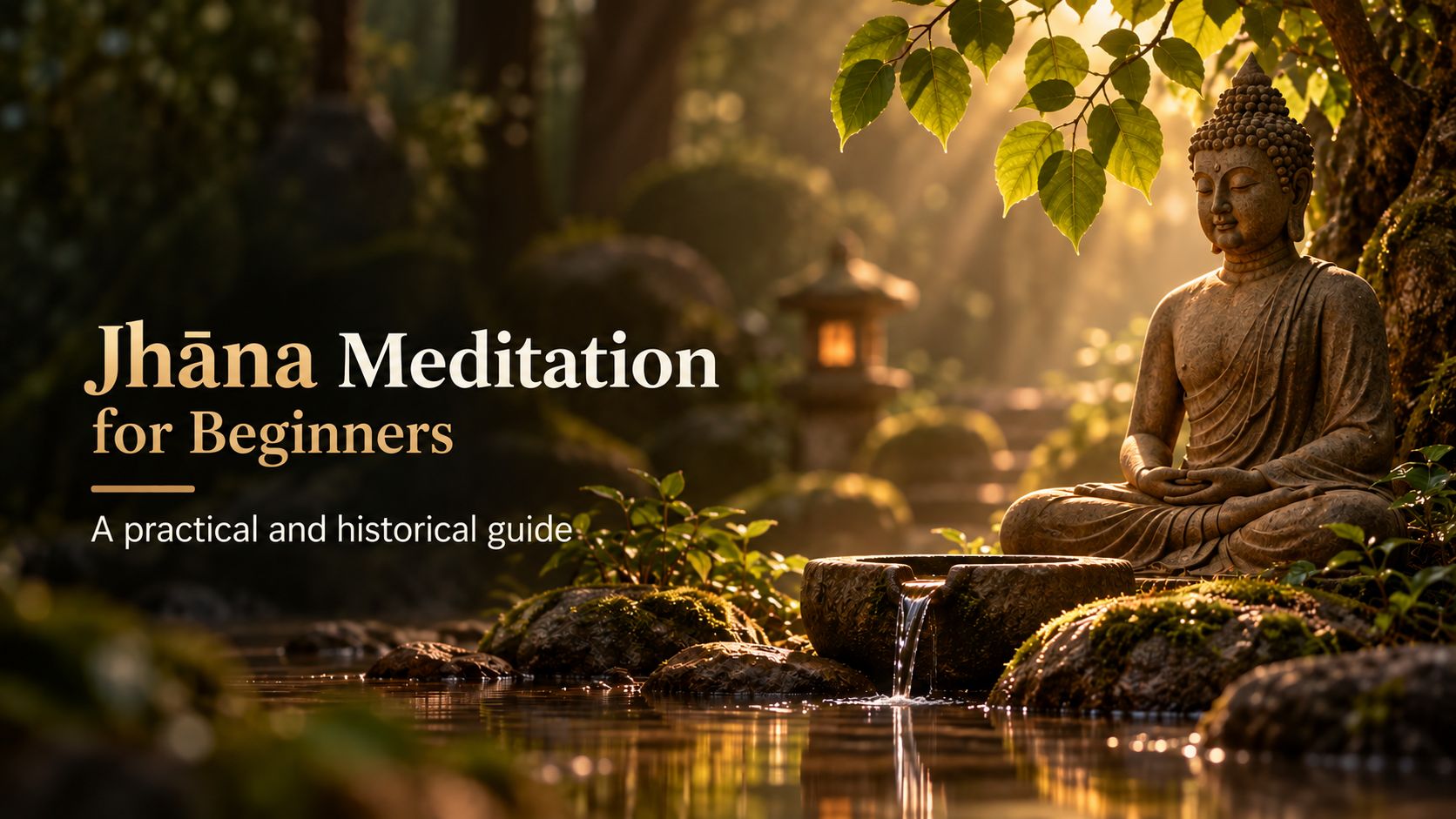
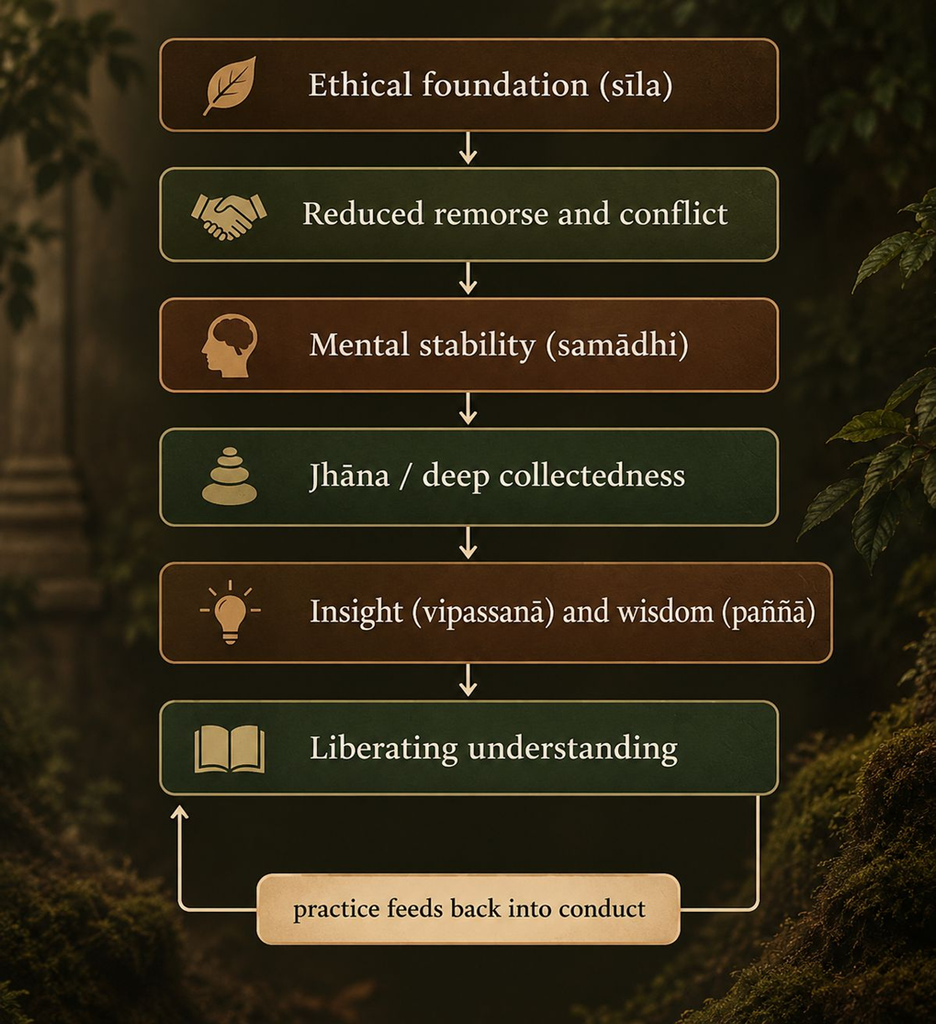
A common high-level summary of Buddhist training is sīla, samādhi, and paññā: ethical conduct, mental collectedness, and wisdom. These are not watertight compartments. Ethical restraint reduces remorse and conflict; reduced conflict supports composure; composure supports clearer seeing; clearer seeing in turn informs conduct. Jhāna belongs primarily to the samādhi dimension of this mutually reinforcing training.
Figure 3 – Sīla, samādhi, and paññā
In SN 45.8, the four jhānas define sammā-samādhi, Right Samādhi. This gives them canonical importance. Yet Buddhist traditions disagree over exactly how much jhāna is required for awakening and how to interpret passages about “dry insight,” momentary concentration, or insight developed in and around jhāna. Some lineages treat strong absorption as indispensable; others teach insight paths that do not require mastery of deep absorption.
Samatha means calming or tranquility; vipassanā means clear seeing or insight. They are often taught as two meditation families, but the early discourses do not treat them as two completely separate mental faculties. A tranquil mind can see more clearly, and insight can reduce agitation by undermining distorted views and grasping. Later manuals and modern retreat systems may separate the methods more sharply for pedagogical reasons.
| Key takeaway: Jhāna is central to the canonical description of Right Samādhi, but Buddhist traditions differ over how jhāna, tranquility, and insight are sequenced in actual training. |
References: SN 45.8; MN 44; MN 118; AN 4.41.
The four-jhāna sequence is one of the most repeated meditative formulas in the early discourses. The progression is best understood as refinement rather than accumulation. Each stage lets go of a relatively coarse feature while preserving or deepening stability. What becomes quieter is as important as what remains.
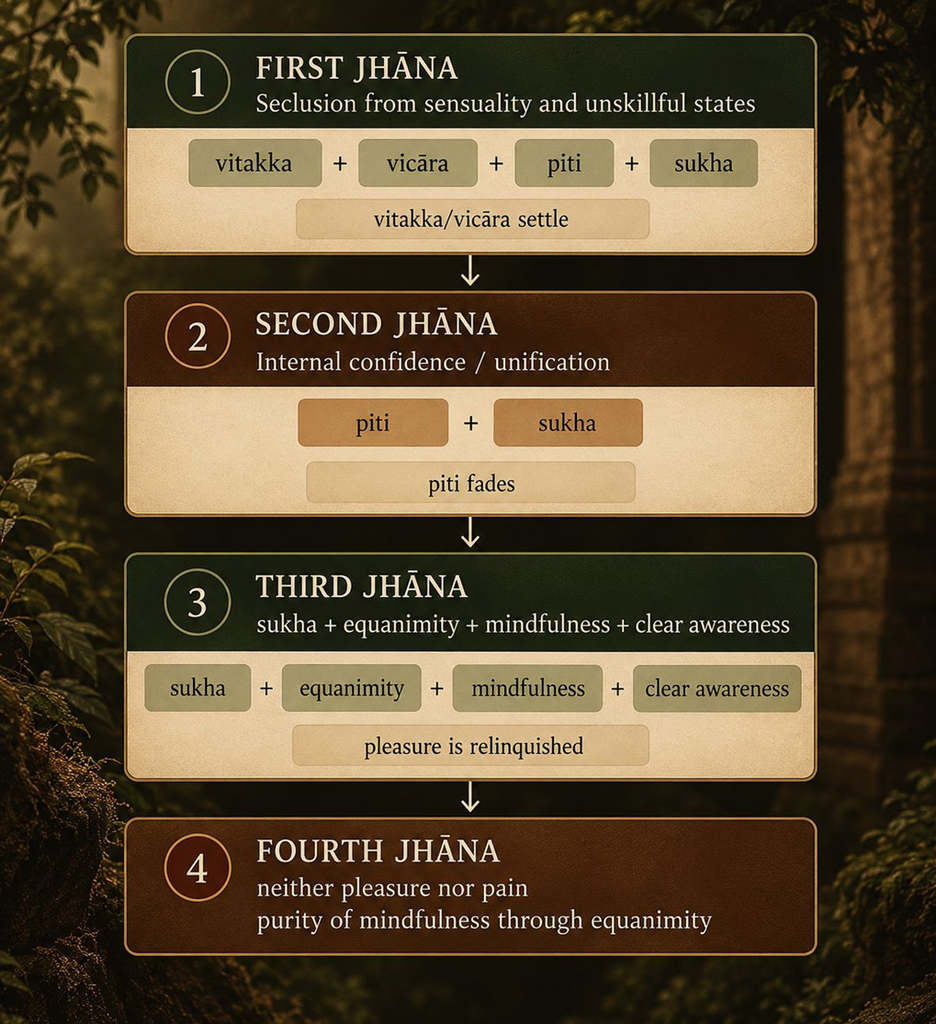
The first jhāna is entered secluded from sensual pleasures and unskillful qualities. It includes pīti (rapture, uplift, energised joy) and sukha (pleasure, ease, well-being) born of seclusion, together with vitakka and vicāra. Translators render these last two terms in different ways: directed thought and evaluation; placing the mind and keeping it connected; initial and sustained application. The disagreement matters because “thought” in English suggests inner speech and discursive reasoning, whereas some interpreters understand the terms as subtle functions of placing and sustaining attention.
What is clear is that the first jhāna is not presented as dull or blank. It is pleasant, energized, and sufficiently unified that the hindrances are not governing the mind. The early simile compares the whole body to bath powder kneaded through with moisture: the pleasure and rapture suffuse the body rather than remaining a tiny point sensation.
As vitakka and vicāra settle, the second jhāna is characterized by stronger internal confidence or clarity, unification, and pīti-sukha born of samādhi. The meditator no longer needs the same degree of intentional placing and maintaining. The mind feels as though it knows what to do by itself.
With the fading of pīti, the third jhāna becomes quieter. Sukha remains, but the energized thrill subsides. Equanimity, mindfulness, and clear awareness become prominent. This illustrates a central principle of jhāna: deeper does not necessarily mean more intense. Refinement often means less excitement, less doing, and greater composure.
With the relinquishment of pleasure and pain and the earlier disappearance of elation and distress, the fourth jhāna is described as neither pleasant nor painful in feeling, with purity of mindfulness due to equanimity. The mind is stable without depending on the rewarding tone of pīti or sukha.
Figure 4 – The four-jhāna progression
| Jhāna | Prominent qualities | What has become quieter | Beginner misunderstanding |
| 1st | Pīti, sukha, stable seclusion; vitakka-vicāra | Five hindrances | “It must contain absolutely no mental movement.” |
| 2nd | Unification, confidence, pīti-sukha | Vitakka-vicāra | “The second is just a stronger first.” |
| 3rd | Sukha, equanimity, mindfulness | Pīti/thrill | “Less rapture means the meditation got worse.” |
| 4th | Equanimity, very clear mindfulness, neutral feeling | Pleasant feeling as a support | “Neutral means emotionally flat or dull.” |
Later Abhidhamma and commentarial systems analyze jhāna factors more explicitly, including ekaggatā, often translated one-pointedness or unification. Early-text discussions of samādhi also use cittekaggatā, “one-pointedness/unification of mind,” but the standard four-jhāna formula itself should not be quietly replaced by later factor lists.
| Key takeaway: The four jhānas form a sequence of refinement or relinquishment: from energized pleasure and active placement toward quiet equanimity and purified mindfulness. |
References: DN 2; SN 45.8; MN 107; MN 39; AN 4.41.