
Purpose
This guide is written for complete beginners as a multi-part blog series. It distinguishes early Buddhist descriptions, later Theravāda commentarial systematization, and modern teaching models instead of presenting them as one uniform doctrine.
Jhāna is a family of deeply collected meditative states described throughout early Buddhist literature. In the standard early-discourse formula, the first four jhānas form the definition of Right Samādhi, the final factor of the Noble Eightfold Path. They are not simply relaxation exercises and they are not identical with ordinary concentration. They involve a progressive settling and unification of mind in which the five hindrances are absent or strongly suppressed, attention becomes unusually stable, and the emotional tone moves from energized joy and pleasure toward increasingly quiet equanimity.
Beginners often encounter the word through very different teaching systems. One teacher may describe jhāna as a stable but still somewhat open state in which some sensory information remains. Another may reserve the word for profound absorption in which ordinary sensory awareness is largely unavailable. A third may require a bright mental sign, or nimitta, before entry. These differences are not merely disagreements about technique; they reflect different textual starting points, later interpretive systems, and modern pedagogical choices.
A useful way to approach the subject is therefore to separate three questions: What do the early discourses actually say? How did later traditions systematize those descriptions? How do contemporary teachers operationalize them for practice? This blog is an attempt to look at those different aspects and show how they overlap.
Figure 1 – Overall progression
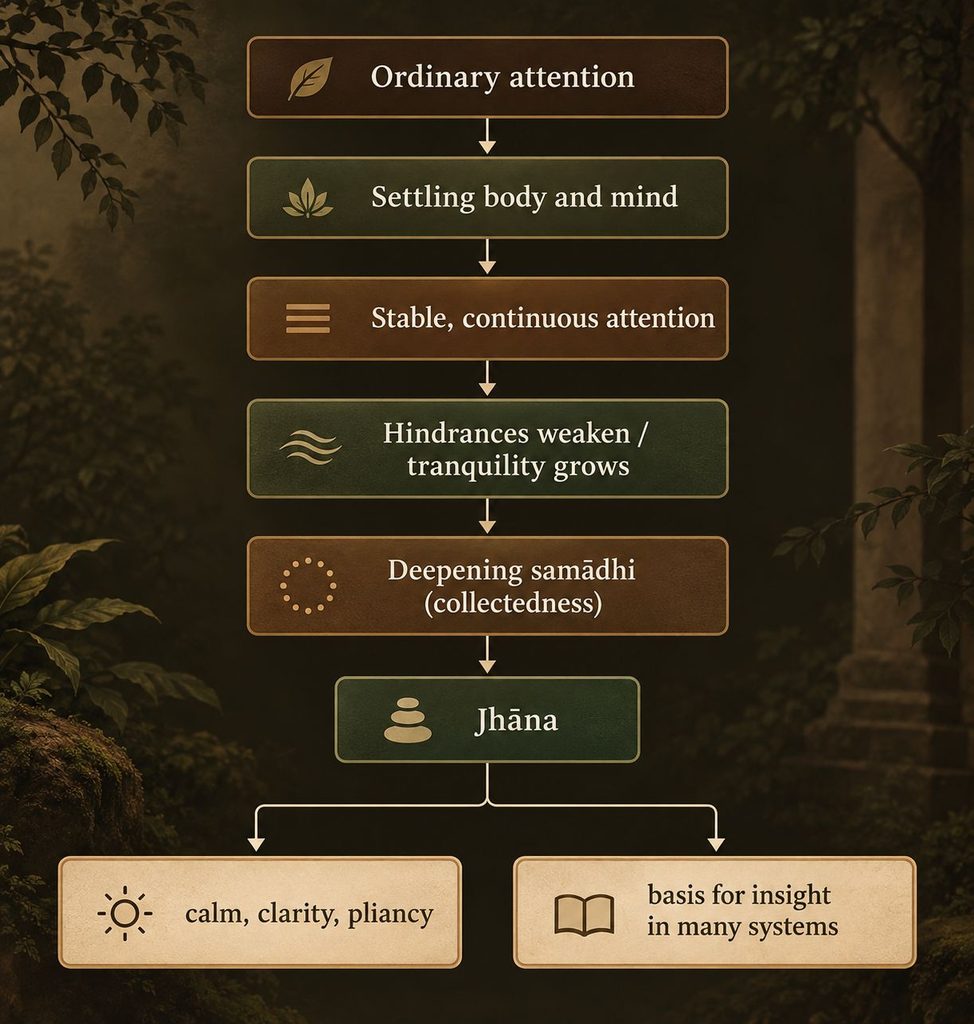
| Key takeaway: Learn the map, but practice the conditions. Stable attention, reduced hindrances, tranquility, and non-grasping matter more than collecting labels. |
References: SN 45.8; DN 2; MN 107; AN 4.41.
Pāli jhāna corresponds to Sanskrit dhyāna, a term for meditative contemplation or absorption. English translators have used words such as absorption, meditative absorption, immersion, trance, concentration, and collectedness. Each choice highlights something and risks obscuring something else. “Absorption” captures depth but can imply total unconsciousness, which is not what the early texts describe. “Concentration” is familiar but too broad, because ordinary concentration can include effort, tension, and task-focused thinking that would not qualify as jhāna.
The broader Pāli term samādhi is often translated as concentration, collectedness, or unification. Jhāna is a particularly important expression of samādhi, but the terms should not simply be treated as synonyms in every context. In SN 45.8, Right Samādhi is defined by the four jhānas. Elsewhere, samādhi is used more broadly for different kinds and developments of mental unification.
| Term/state | Typical character | How it differs from jhāna |
| Relaxation | Reduced tension and arousal | Can occur with a wandering or dull mind; stability and hindrance-reduction may be modest. |
| Everyday concentration | Focused attention on a task | Often includes effort, planning, evaluation, sensory engagement, and goal pressure. |
| Flow | Absorbed performance in an activity | Usually involves skilled action and sensory-motor interaction rather than seated contemplative absorption. |
| Mindfulness (sati) | Remembering/keeping the relevant field in mind with awareness | Can be broad and observational; jhāna is a specific deepening of collectedness. |
| Samādhi | Collectedness/unification of mind | Broader category; the four jhānas are a canonical paradigm of Right Samādhi. |
| Jhāna | Progressively refined meditative collectedness | Classically marked by changing combinations of rapture, pleasure, equanimity, mindfulness, and thought-related factors. |
| Definition: In this guide, “jhāna” refers to the four form jhānas described in the early Buddhist discourses unless another framework is explicitly named. |