Jhāna practice becomes easier when the meditator’s life is not continuously generating agitation. Classical Buddhist training therefore begins with ethical conduct, restraint, contentment, and a supportive environment. A secular practitioner can translate this into straightforward conditions: avoid conduct that produces guilt and conflict, sleep adequately, reduce needless stimulation, practice consistently, and choose a posture that is alert without being rigid.
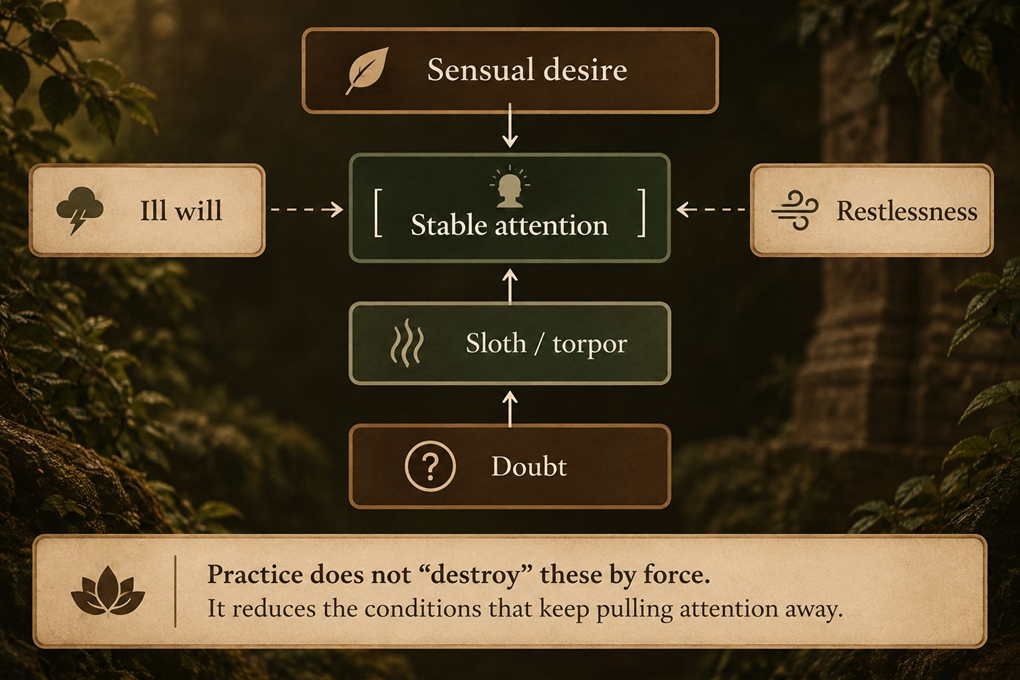
The five hindrances are recurring patterns that disperse or destabilize attention. They are not moral failures; they are diagnostic categories for what the mind is doing right now.
| Hindrance | How it feels in meditation | Useful effort to counter |
| Sensual desire | Planning pleasures, replaying attractive images, reaching for stimulation | Notice the reward-seeking loop; simplify the field; reconnect with contentment and the meditation object. |
| Ill will | Irritation, resentment, self-criticism, argument rehearsal | Soften the body; acknowledge the aversion; use kindness or patience; avoid fighting the irritation with more irritation. |
| Sloth and torpor | Heavy, foggy, sinking attention | Straighten posture, open eyes briefly, increase energy, use a clearer object, practice earlier or after adequate sleep. |
| Restlessness and remorse | Jumping attention, nervous energy, replaying mistakes | Lengthen settling time; relax effort; acknowledge unresolved concerns; use slower, broader breathing awareness. |
| Doubt | “Am I doing this right?” repeated during the sit | Use a simple method for the entire session; evaluate after meditation rather than renegotiating every minute. |
Figure 7 – Hindrances disrupt the center
References: DN 2; MN 107; AN 5.51; AN 9.64.
Buddhist traditions use many meditation objects. The object is not magic; it is a stable theme around which attention, ease, and unification can develop. Different objects suit different temperaments and lineages.
| Method | Meditation object | Basic process | Strengths | Common difficulty |
| Mindfulness of breathing (ānāpānasati) | Breathing process | Know breathing clearly; allow it to become refined; cultivate continuity, tranquility, and gladdening or steadying the mind | Portable, canonical, subtle enough to deepen | Over-control of breath; turning observation into breath engineering |
| Whole-body breathing | Breath together with the felt body/whole breathing process | Broaden awareness so breathing, bodily ease, and tranquility form one field | Can support embodied pīti-sukha and reduce narrow tension | Too broad for some beginners; can become vague |
| Pleasant sensation/pīti-sukha approach | A wholesome pleasant tone arising after sufficient stability | Let stable attention rest with non-sensual pleasure, then allow it to spread and unify | Directly trains canonical first-jhāna qualities in some modern systems | Chasing pleasure or manufacturing excitement |
| Kasiṇa | A visual/material theme such as earth or color, later mental sign | Stabilize perception of the chosen object and, in commentarial systems, develop a mental counterpart sign | Highly structured traditional concentration technology | Can feel technical; requires careful instruction in classical systems |
| Mettā | Loving-kindness/goodwill | Cultivate a steady, inclusive affective intention and allow unification around it | Useful when ill will or self-criticism dominates | May become verbal repetition without emotional unification |
| Other samatha objects | Recollections, elements, body themes, etc. | Use a traditional object with appropriate instructions | Offers alternatives for different temperaments | Not every object is said in later manuals to lead to every depth of jhāna |
MN 118 is especially useful because it does not present breath meditation as a crude laser focus on one tiny point. It describes knowing long and short breathing, experiencing the whole body or whole breathing process, calming bodily activity, experiencing rapture and pleasure, gladdening the mind, steadying it in samādhi, and eventually contemplating impermanence and relinquishment. Interpretations of individual steps differ, but the overall arc is richer than “stare at the nostrils until something happens.”
References: MN 118; MN 119; Visuddhimagga Chapters IV–IX for later object systematization.
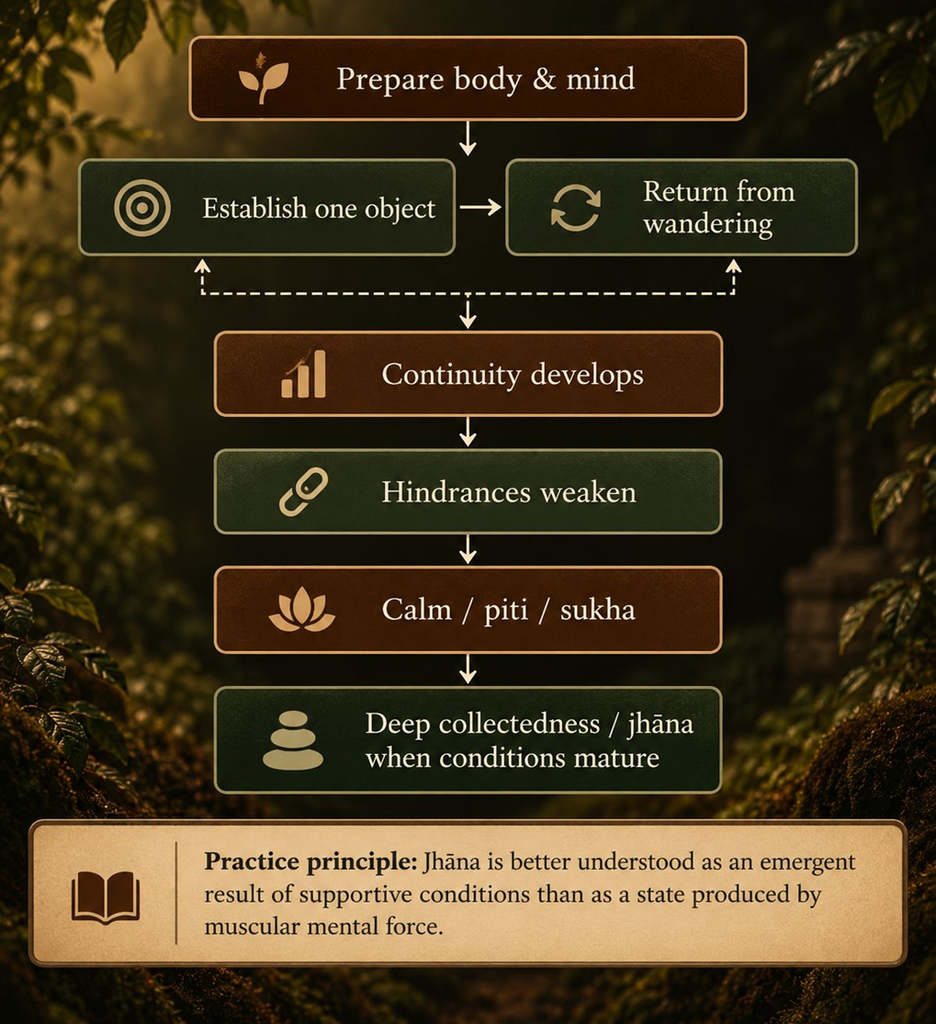
The following framework is deliberately generic. It is not a claim that every tradition enters jhāna in exactly these stages. It gives a beginner a safe sequence of skills that are useful across many systems.
Sit in a stable, comfortable position. Let the spine support alertness while the face, jaw, shoulders, abdomen, and hands soften. Spend enough time settling that meditation is not merely the continuation of the previous activity at slower speed.
Use the breath, mettā, a suitable kasiṇa, or another method you understand. Decide before the session what you are practicing. Frequent mid-sit switching trains indecision more efficiently than samādhi.
When attention wanders, recognize the wandering and return without drama or force. The skill is not never becoming distracted; the skill is shortening the period of unconscious distraction and reducing the emotional reaction to it. However, you should not do it forcefully.
As returns become gentler and less frequent, attention starts to feel continuous. Avoid tightening around the object. Stable attention is more like holding a cup steadily than crushing it.
When the hindrances recede, ease can become noticeable. Depending on the method, this may appear as bodily comfort, warmth, lightness, joy, subtle energy, or simply relief from mental conflict. Do not force pīti. Let pleasantness be recognized and supported without grabbing it.
As the meditation becomes rewarding in its own right, less effort is required. This is a crucial transition: excessive control can now become the disturbance. The meditator learns when to stop “helping.”
If a stable jhāna-like state emerges, stay with the dominant quality rather than immediately questioning which numbered stage it is. Classification is better done afterwards, when the mind is no longer trying to maintain the state.
Figure 8 – Positive feedback in concentration
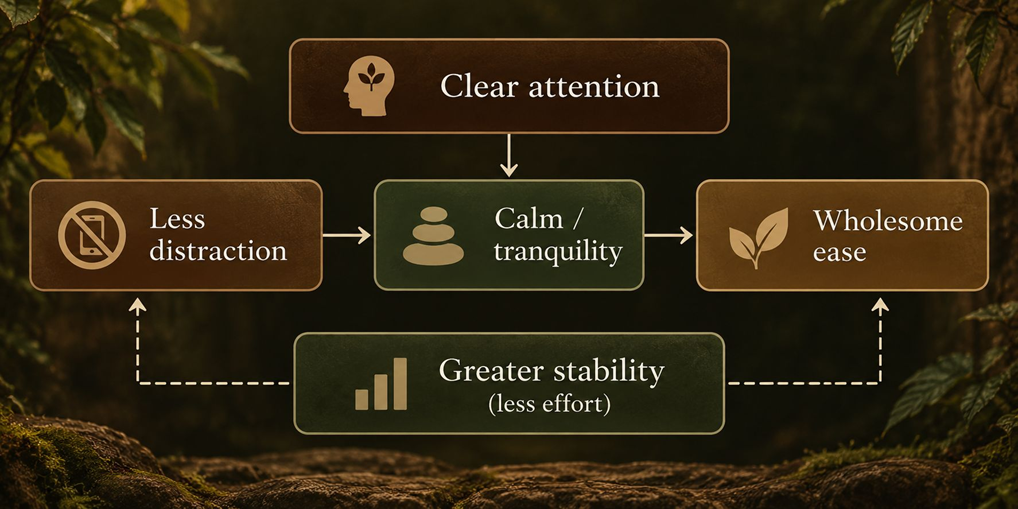
Figure 9 – High-level session flow